Turmeric vs. Ibuprofen for Joint Pain: What Research Really Says
Joint pain affects millions of people worldwide, especially those with osteoarthritis or age-related inflammation.Many people compare turmeric vs ibuprofen for joint pain to understand which option is more effective and safer for long-term use.
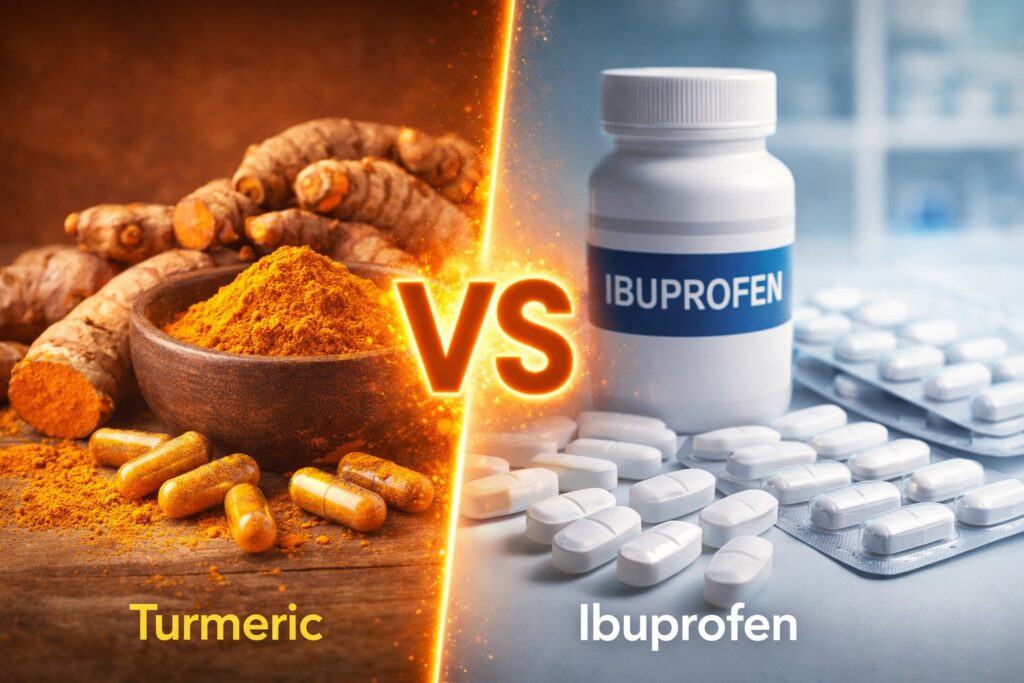
Many people rely on ibuprofen for pain relief, but growing research suggests that curcumin — the active compound in turmeric — may provide similar benefits with fewer side effects. This is why comparisons like turmeric vs ibuprofen for joint pain have become increasingly important in recent years.
In this article, we examine what clinical research actually says about turmeric vs. ibuprofen for joint pain. For more detailed clinical evidence, see our guide on curcumin for osteoarthritis clinical studies.
Introduction
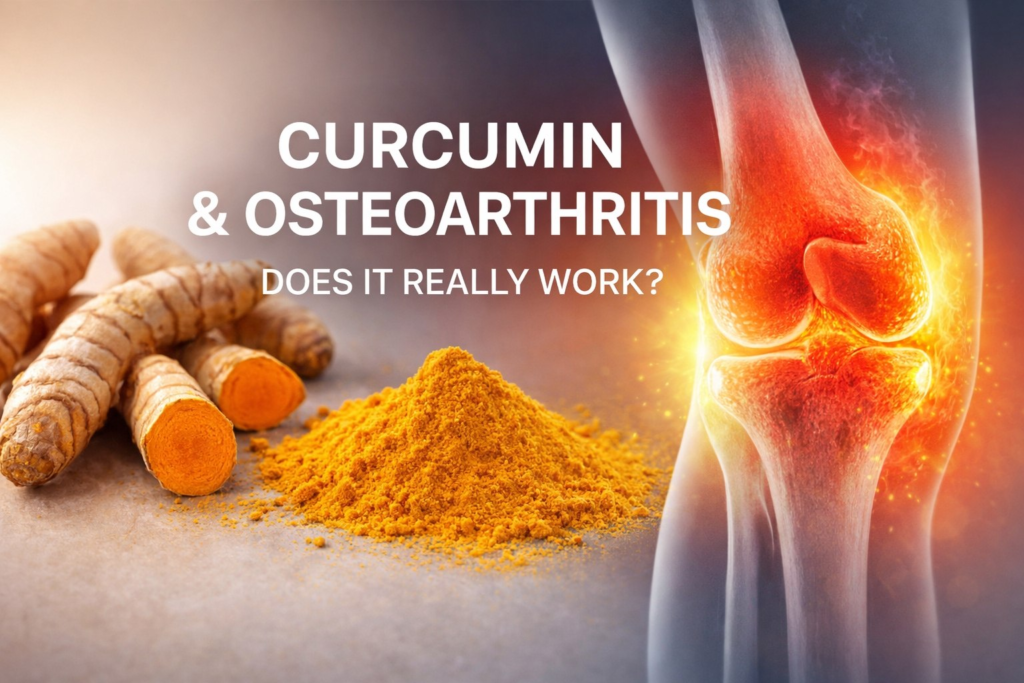
Joint pain is one of the most common health concerns worldwide, especially among people with osteoarthritis. Osteoarthritis occurs when the cartilage that cushions the joints gradually wears down, causing pain, stiffness, and reduced mobility.
Many people rely on medications such as ibuprofen, a widely used non-steroidal anti-inflammatory drug (NSAID), to manage inflammation and pain. While ibuprofen can be effective for short-term relief, long-term use may sometimes lead to side effects such as stomach irritation or digestive discomfort.
Because of this, researchers have been studying natural compounds that may support joint health. One of the most promising is curcumin, the primary active compound found in turmeric. But how does turmeric compare with ibuprofen? Several clinical studies have examined this question.
Understanding Joint Pain and Inflammation: Turmeric vs Ibuprofen for Joint Pain
Inflammation plays a major role in many joint disorders. When joint tissues become damaged or irritated, the body releases inflammatory chemicals that increase pain sensitivity and swelling.
This inflammatory response can lead to symptoms such as:
•joint stiffness
•swelling
•reduced range of motion
•persistent pain Reducing inflammation is therefore one of the main goals of treatments for joint discomfort
How Ibuprofen Works
Ibuprofen belongs to a class of medications known as NSAIDs (non-steroidal anti-inflammatory drugs).
These medications reduce inflammation by blocking enzymes called COX-1 and COX-2, which are responsible for producing prostaglandins—chemical compounds that contribute to pain and inflammation.
By reducing prostaglandin production, ibuprofen can help relieve:
•Joint pain
•Swelling
•Stiffness
However, frequent or long-term use of NSAIDs may sometimes cause side effects, particularly in the digestive system.
What Is Curcumin?
Curcumin is the main biologically active compound found in turmeric (Curcuma longa). It is a polyphenol that has been widely studied for its anti-inflammatory and antioxidant properties.
How Curcumin Works in the Body
Research suggests that curcumin may:
•Inhibit the activity of NF-κB, a key molecule that regulates inflammatory responses.
•Reduce the production of inflammatory cytokines such as TNF-α and interleukin-6.
•Suppress enzymes like COX-2 and lipoxygenase, which contribute to inflammation.
•Act as a strong antioxidant, helping neutralize free radicals that may damage joint tissues.
•Because curcumin targets several inflammatory pathways simultaneously, researchers believe it may help support joint health through a broader mechanism compared with single-target drugs.
However, one limitation is that curcumin has low natural bioavailability, meaning the body does not absorb it easily. For this reason, many curcumin supplements include piperine (black pepper extract) or specialized formulations designed to improve absorption.
Clinical Study: Curcumin vs Ibuprofen
One of the most frequently cited studies compared turmeric extract directly with ibuprofen in patients with knee osteoarthritis.
In this randomized clinical trial by Kuptniratsaikul et al. (2014), 367 patients were assigned to receive either 1,500 mg of Curcuma domestica extract daily, or 1,200 mg of ibuprofen daily.
Participants were treated for four weeks. Researchers evaluated pain and joint function using the WOMAC score, a widely used assessment tool in osteoarthritis research.
The results showed that both groups experienced significant improvements in pain and physical function. Importantly, the turmeric extract was found to be non-inferior to ibuprofen, meaning it provided similar symptom improvement.
The study also reported that participants taking turmeric experienced fewer gastrointestinal side effects compared with those taking ibuprofen.
These findings suggest that curcumin-rich turmeric extracts may offer a natural option for supporting joint comfort. Overall, research comparing turmeric vs ibuprofen for joint pain suggests both can reduce symptoms, but their safety profiles differ.
Additional Clinical Evidence
Another study conducted by Belcaro et al and colleagues in 2010 investigated a specialized curcumin formulation known as Meriva® in osteoarthritis patients.
In this study, 100 patients with knee osteoarthritis received 1,000 mg of Meriva per day (providing about 200 mg of curcumin) for eight months, alongside standard treatments such as NSAIDs or analgesics.
The researchers observed improvements in:
•WOMAC scores
•Joint function
•Walking distance
However, it is important to note that this study combined curcumin with NSAID therapy rather than directly comparing the two treatments. In addition, the participants were relatively young and had mild osteoarthritis severity. Because of these factors, further research is still needed to fully understand how curcumin performs across different populations.
Potential Benefits of Curcumin for Joint Pain: Turmeric vs Ibuprofen

Based on current research, curcumin may offer several potential benefits.
Anti-Inflammatory Support
Curcumin can influence multiple inflammatory pathways, which may help regulate inflammation in joint tissues.
Antioxidant Activity
Curcumin also acts as an antioxidant, helping neutralize free radicals that may contribute to tissue damage.
Improved Joint Mobility
Some clinical studies suggest curcumin supplementation may help improve mobility and reduce stiffness in individuals experiencing joint discomfort.
Why Curcumin Supplements Are Often Used
Although turmeric is commonly used as a spice, the amount of curcumin in regular turmeric powder is relatively low.
Most clinical studies use standardized curcumin extracts, which provide higher concentrations of the active compound.
In addition, curcumin is not easily absorbed by the body. Many supplements include piperine (black pepper extract) to improve absorption.
For this reason, people who want to use turmeric for joint health often choose standardized curcumin supplements.
Choosing a Quality Curcumin Supplement

If you are considering curcumin supplementation, many experts recommend looking for products that contain:
standardized curcumin extract
high curcuminoid concentration
black pepper extract (piperine) for absorption. If you ar looking for a high quality best curcumin supplement read this article.
Conclusion
When comparing turmeric vs ibuprofen for joint pain, research suggests both may help reduce pain and inflammation. However, turmeric may offer a safer long-term option for some individuals, while ibuprofen provides faster short-term relief. The best choice depends on individual needs, medical history, and treatment goals.
Related Articles
Curcumin for Osteoarthritis: Does It Really Work or Just Hype?
Curcumin for Knee Osteoarthritis: What Clinical Studies Really Show
Curcumin for Rheumatoid Arthritis: What Clinical Studies Really Show (2026 Evidence-Based Guide)
Why This Curcumin Supplement Is Gaining Attention Online (2026 Review)
About the Moviva Research Team
The Moviva Research Team focuses on evidence-based wellness, nutrition, inflammation research, and natural health topics. Our goal is to simplify scientific research into practical, reader-friendly health information backed by published studies and clinical evidence.
We analyze human trials, animal studies, systematic reviews, meta-analyses, and emerging research adn sometimes traditional medicines uses related to arthritis, joint health, inflammation, nutrition, supplements, and lifestyle medicine to make science and experinece based articles for the public.
Medical Disclaimer
This article is for educational and informational purposes only and does not constitute medical advice. Always consult a qualified healthcare professional before making dietary or supplement changes, especially if you have arthritis or take medications.
References
Kuptniratsaikul V, Dajpratham P, Taechaarpornkul W, et al.
Efficacy and safety of Curcuma domestica extracts compared with ibuprofen in patients with knee osteoarthritis: a multicenter study. Clinical Interventions in Aging. 2014;9:451–458.
https://pmc.ncbi.nlm.nih.gov/articles/PMC3964021/
Product-evaluation registry of Meriva(R), a curcumin-phosphatidylcholine complex, for the complementary management of osteoarthritis
Belcaro et al and colleagues in 2010
https://www.researchgate.net/publication/51444532_Product-evaluation_registry_of_MerivaR_a_curcumin-phosphatidylcholine_complex_for_the_complementary_management_of_osteoarthritis