
Boswellia for Knee Osteoarthritis: What Clinical Studies Show
Introduction
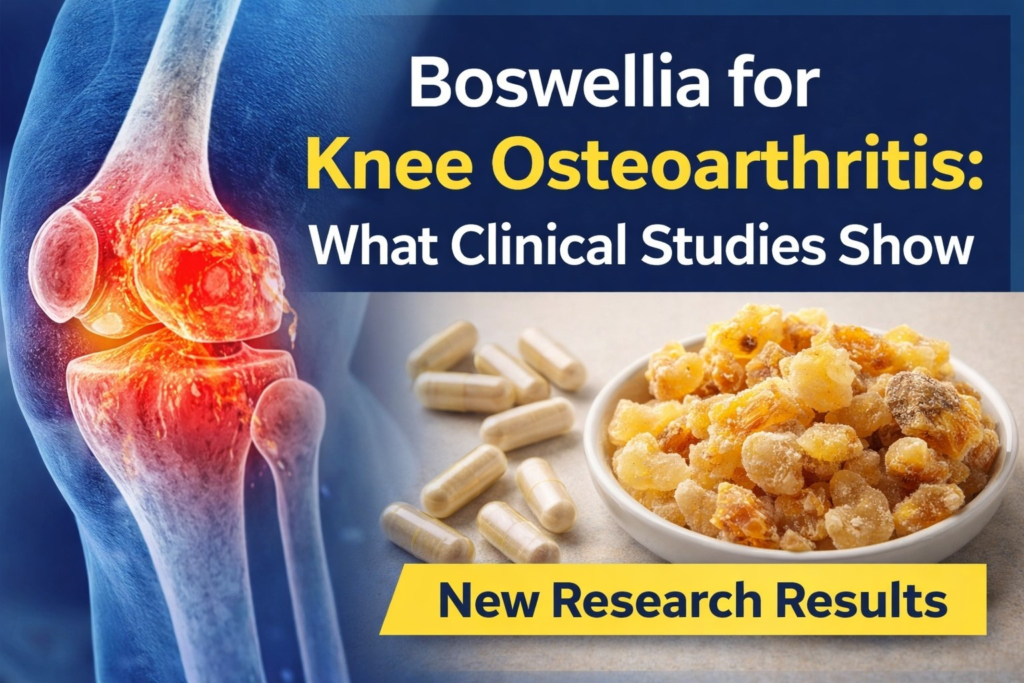
Boswellia for knee osteoarthritis is a powerful natural option for reducing joint pain, inflammation, and improving mobility.
Boswellia serrata, commonly known as Indian frankincense, has gained increasing attention as a natural compound for managing joint pain and inflammation. It has been used for centuries in traditional medicine, particularly in Ayurveda, for inflammatory conditions.
Knee osteoarthritis is a degenerative joint disorder characterized by cartilage breakdown, pain, stiffness, and reduced mobility. While conventional treatments such as non-steroidal anti-inflammatory drugs (NSAIDs) are widely used, concerns about long-term side effects have led to growing interest in alternative approaches.
Boswellia contains active compounds known as boswellic acids, which are believed to influence inflammatory pathways in the body. Recent clinical studies, including randomized controlled trials and meta-analyses, suggest that Boswellia may help reduce pain and improve physical function in individuals with osteoarthritis.
If you’re wondering whether boswellia truly delivers real results, read our detailed guide on boswellia for osteoarthritis: does it really work or just hype.
Understanding Knee Osteoarthritis
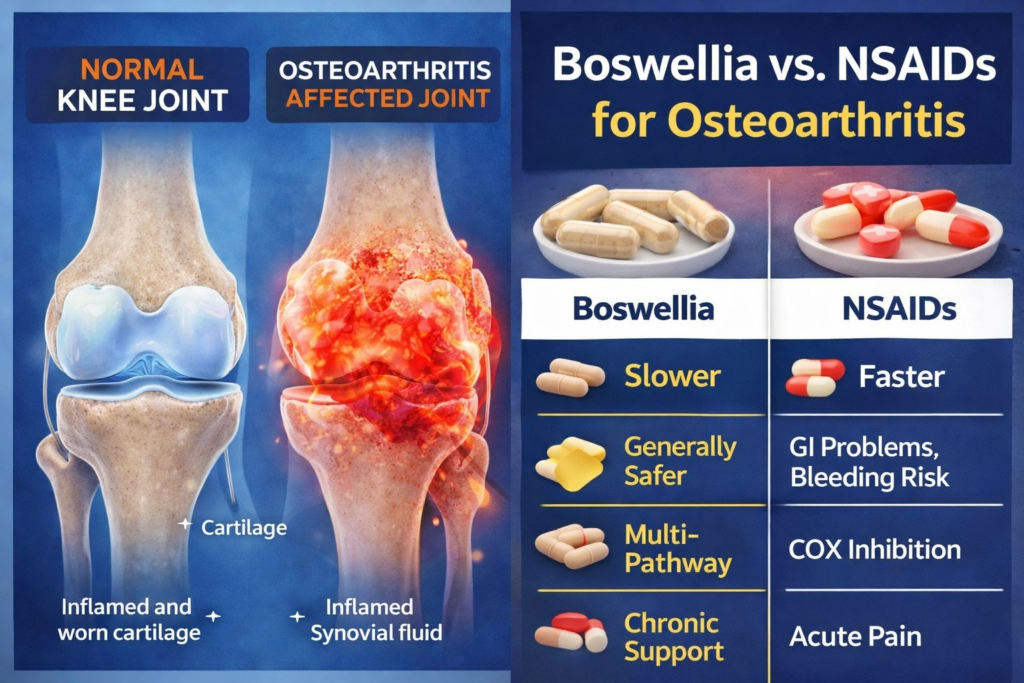
Knee osteoarthritis occurs when the cartilage that cushions the joint gradually deteriorates. This leads to increased friction between bones, causing pain, inflammation, and stiffness.
It commonly affects older adults but may also occur due to obesity, joint injury, or repetitive stress. Because the knee bears body weight, it is especially vulnerable.
Symptoms include persistent pain, reduced mobility, stiffness after rest, and difficulty performing daily activities such as walking or climbing stairs. Boswellia for knee osteoarthritis is often considered when patients look for natural anti-inflammatory support.
What Is Boswellia
Boswellia serrata is a plant extract obtained from the resin of the Boswellia tree. It contains active compounds called boswellic acids, which have been studied for their anti-inflammatory properties. Boswellia for knee osteoarthritis comes from a herbal extract known for its anti-inflammatory properties.
Unlike many conventional drugs, Boswellia appears to target multiple inflammatory pathways, making it a potential natural option for managing conditions such as osteoarthritis.
How Boswellia May Help Reduce Joint Inflammation
Boswellia for knee osteoarthritis has been widely studied for its anti-inflammatory effects.
Boswellia works primarily by inhibiting the enzyme 5-lipoxygenase (5-LOX), which is involved in the production of leukotrienes — inflammatory molecules that contribute to joint pain and swelling.
By reducing leukotriene production, Boswellia may help decrease inflammation, improve joint comfort, and support mobility.
It may also influence cytokines and other inflammatory mediators, further contributing to its anti-inflammatory effects.
Evidence From Clinical Studies
A systematic review and meta-analysis conducted by Ganpeng Yu et al. (2020) analyzed randomized controlled trials evaluating Boswellia in osteoarthritis patients.
The analysis included 7 clinical trials with a total of 545 participants.
The results showed that Boswellia supplementation significantly improved:
Pain scores (VAS and WOMAC)
Joint stiffness
Physical function (WOMAC function, Lequesne index)
The study also found that:
Minimum effective duration was approximately 4 weeks
Most benefits were observed with continued use
Boswellia was generally well tolerated. Overall, evidence supports that boswellia for knee osteoarthritis can significantly improve pain and joint function.
A more recent systematic review and meta-analysis of human clinical trials by Vishal Dubery et al 2024 evaluating standardized Boswellia serrata extract also confirmed significant improvements in pain, stiffness, and physical function in osteoarthritis patients.
Importantly, these analysis included only human trials, strengthening the reliability and clinical relevance of these findings.
Clinical Trials Summary (Detailed)
Study 1 (Kimmatkar et al.)
Participants: ~30 patients
Dose: ~333 mg (3 times daily)
Duration: 8 weeks
Outcome: Reduced knee pain and improved function
Study 2 (Sengupta et al., 5-Loxin)
Participants: 75 patients
Dose: 100 mg/day and 250 mg/day
Duration: 90 days
Outcome: Improved WOMAC scores and reduced stiffness
Study 3 (Sengupta et al., Aflapin)
Participants: ~60 patients
Dose: ~100 mg/day
Duration: 90 days
Outcome: Faster pain relief and improved mobility
Study 4 (Vishal et al.)
Participants: ~66 patients
Dose: 250 mg/day
Duration: 6 months
Outcome: Reduced pain and improved mobility
Study 5 (Sontakke et al.)
Participants: 66 patients
Comparison: Boswellia vs NSAIDs
Duration: 6 months
Outcome: Comparable results to NSAIDs
Study 6 (Majeed et al.)
Participants: ~70 patients
Dose: 300–600 mg/day
Duration: 90 days
Outcome: Improved walking ability and reduced stiffness
Study 7 (Combination extract trial)
Participants: ~50 patients
Dose: ~100–250 mg boswellic acids
Duration: 4–12 weeks
Outcome: Reduced inflammation and improved function
Potential Benefits of Boswellia
Based on current research, Boswellia may provide several benefits:
Reduction in joint pain
Improvement in mobility and physical function
Decrease in joint stiffness
Anti-inflammatory effects
Favorable safety profile compared to NSAIDs.
Patients using boswellia for knee osteoarthritis often report improved mobility and reduced stiffness.
Limitations of Current Research
Despite promising findings, several limitations exist:
Variations in dosage and formulations
Moderate sample sizes in studies
Short study durations (often 4–12 weeks)
Limited long-term safety data
Because of these factors, further large-scale trials are needed.
Conclusion
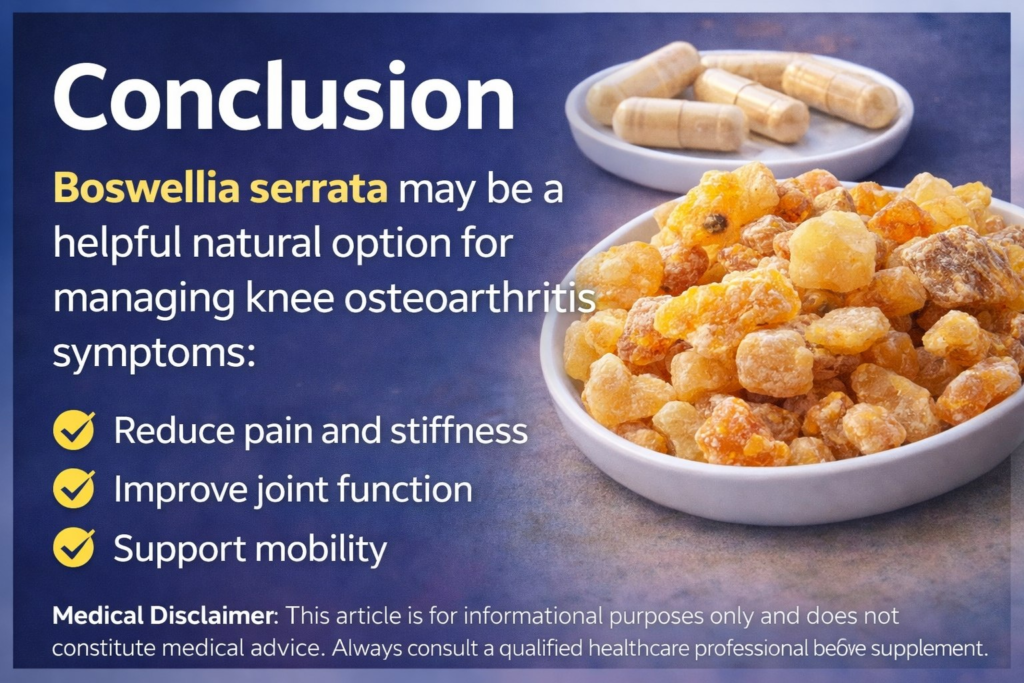
Clinical evidence suggests that Boswellia serrata may be a promising natural option for managing symptoms of knee osteoarthritis. It may help reduce pain, improve joint function, and support mobility.
In summary, boswellia for knee osteoarthritis is a promising natural option supported by clinical research. However, results may vary depending on formulation and dosage, and Boswellia should be considered a supportive approach rather than a replacement for medical treatment.
About the Moviva Research Team
The Moviva Research Team focuses on evidence-based wellness, nutrition, inflammation research, and natural health topics. Our goal is to simplify scientific research into practical, reader-friendly health information backed by published studies and clinical evidence.
We analyze human trials, animal studies, systematic reviews, meta-analyses, and emerging research adn sometimes traditional medicines uses related to arthritis, joint health, inflammation, nutrition, supplements, and lifestyle medicine to make science and experinece based articles for the public.
Medical Disclaimer
This article is for educational and informational purposes only and does not constitute medical advice. Always consult a qualified healthcare professional before making dietary or supplement changes, especially if you have arthritis or take medications.
References
Ganpeng Yu et al. (2020)
Boswellia serrata extract for osteoarthritis: a systematic review and meta-analysi
https://pmc.ncbi.nlm.nih.gov/articles/PMC7368679/
Vishal Dubery et al 2024
Evaluation of standardized Boswellia serrata extract in osteoarthritis – Systematic review and meta-analysis of human clinical trials
https://www.sciencedirect.com/science/article/abs/pii/S1550830724000090



Pingback: Curcumin for Knee Osteoarthritis: What Clinical Studies Really Show – Moviva Health